


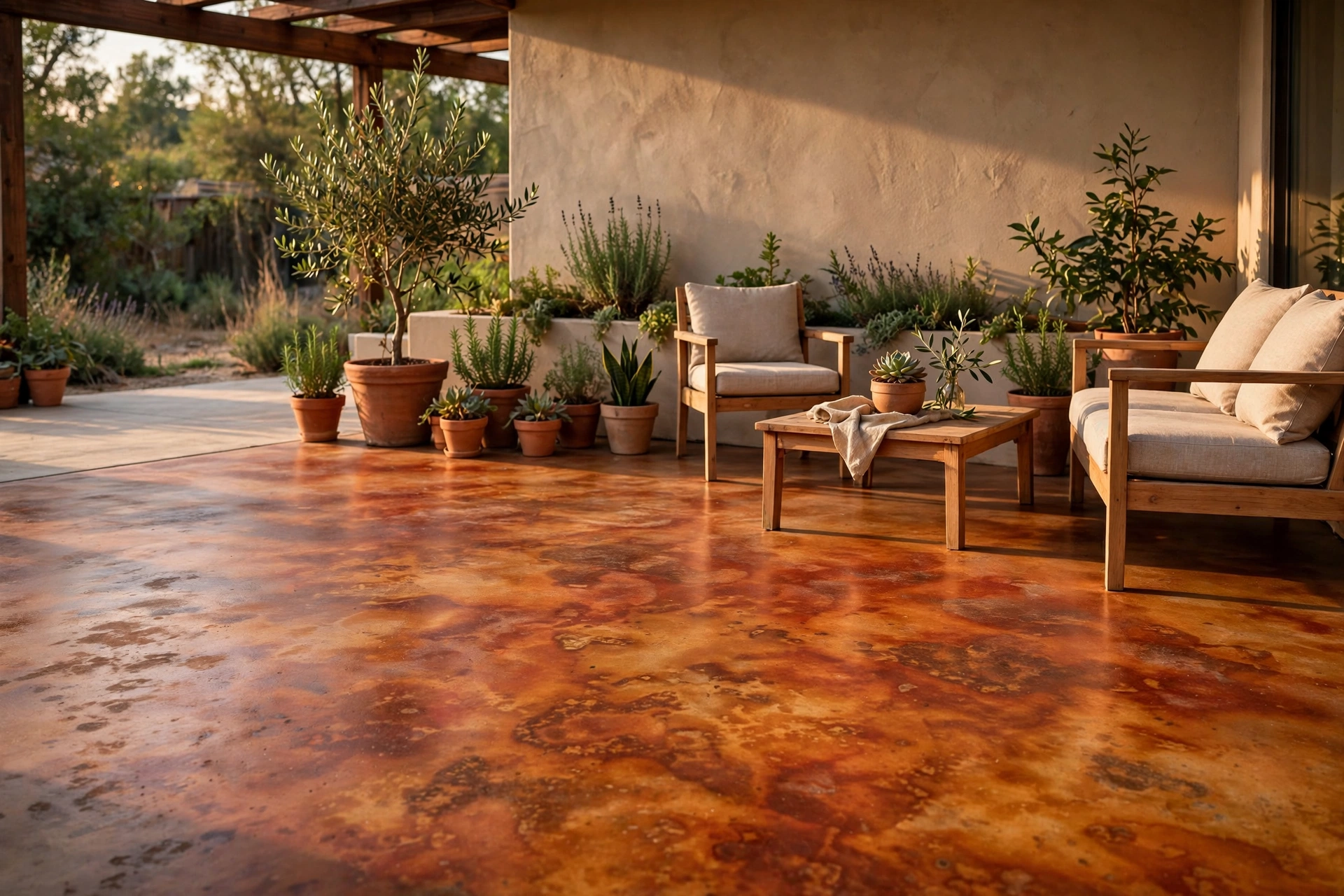
Concrete stain is a coloring treatment that soaks into concrete instead of coating the top of it. The color forms inside the surface layer of the slab itself. Because the color lives in the concrete, it cannot chip, flake, or peel away like paint. Two types of stain do this job in very different ways. Acid stain reacts chemically with the lime inside the concrete. It leaves permanent, translucent color with a marbled, natural-stone look. Water-based stain carries pigment into the pores of the slab instead. Its color is more even, more predictable, and far more varied. Both types work on interior floors, patios, pool decks, garages, and driveways. Both also demand the same groundwork before you start. The slab must be clean, bare, and fully cured. This guide explains each stain type, the colors you can realistically expect, and what the job costs. It then walks through preparation, application, sealing, and the mistakes that spoil the finish.
What Is Concrete Stain?
Concrete stain adds color without hiding the slab underneath it. Most stains are translucent, so the texture of the concrete still shows through. Trowel marks, small pits, and natural shading all stay visible. Stains also react with each slab in a slightly different way. The age of the concrete, its mix, and its porosity all shape the final color. Two floors treated with the same product rarely look identical. Concrete Network, the industry’s best-known information source, stresses this point often. That one-off character is exactly what many people want from the finish.
Stain is not the same product as concrete dye, and the two are often confused. Dyes use much finer color particles and produce brighter, more uniform color. Contractors often pair dyes with polished concrete on indoor floors. Stains remain the standard choice for most homes, patios, and garages. This guide covers stains, in both of their forms.
Acid Stain vs Water-Based Stain: The Two Types Explained
Every concrete stain on the shelf belongs to one of two families. Acid stains are reactive, which means the concrete itself helps create the color. Water-based stains are non-reactive, so the color you see is the color you mixed. The difference shapes everything from the palette to the cleanup.
Acid Stain (Reactive Stain)
Acid stain is a water solution of inorganic metallic salts and a mild acid. The acid is usually hydrochloric acid, also sold as muriatic acid. Once sprayed on, the solution sinks into the surface pores. The metallic salts then react with calcium hydroxide, the free lime inside cured concrete. That reaction creates insoluble colored compounds locked inside the slab. The color is therefore permanent, and it will not fade, chip, or peel.
The look is translucent and variegated, with soft marbling across the surface. Manufacturers describe the effect as antiqued or mottled. Color develops slowly, over roughly 5 to 24 hours depending on the brand. The trade-offs are real, though. You handle a corrosive product, and the color is hard to predict exactly. Acid stain also needs a neutralizing wash before sealing, which water-based products skip.
Water-Based Stain (Non-Reactive Stain)
Water-based stains are usually a blend of acrylic polymers and pigments. No chemical reaction takes place with the concrete. Instead, the pigment fills the pores and the acrylic forms a thin colored film. Depending on the product, that film can be translucent or nearly opaque. Color is consistent from one section of slab to the next. Most water-based stains are low in VOCs and contain no solvents or acids. Cleanup is easier, and the smell during application is mild. Those traits make water-based stain the friendlier choice for occupied homes and indoor floors.
| Feature | Acid Stain | Water-Based Stain |
|---|---|---|
| How it colors | Chemical reaction with lime in the slab | Pigment fills the pores; acrylic film forms |
| Color range | About 8 hues, mostly earth tones | Dozens of colors, including black, white, metallics |
| Final look | Translucent, mottled, marbled | Translucent to opaque, more uniform |
| Predictability | Low; every slab reacts differently | High; the wet color is close to the result |
| Extra steps | Neutralizing and heavy rinsing required | No neutralizing step |
| Safety and cleanup | Corrosive; gloves, goggles, ventilation needed | Low VOC; usually soap-and-water cleanup |
| Best for | Patios, driveways, rustic floors, stone effects | Indoor floors, bright colors, detailed designs |
Concrete Stain Colors: What Your Options Actually Look Like
Concrete stain colors split sharply along the acid and water-based divide. Most acid stain lines offer only about eight hues. They sit in the earth family: tans, browns, terra cottas, and soft blue-greens. Black and deeper greens appear in some lines as well. You can mix two acid colors before spraying, or layer one over another. A second coat also deepens the color you already have.
Water-based ranges are far wider. Most manufacturers list dozens of standard colors, and many can be mixed like paint. That range opens up grays, blues, reds, and clean whites that acid stain cannot reach. Solid-color water-based products can even hide a tired slab behind an even finish.
Whichever family you choose, test before you commit. The liquid color of an acid stain often looks nothing like the reacted color. The true shade appears only after several hours on the slab. Sealer changes the picture again. A gloss sealer makes the color look close to its wet state. A matte sealer keeps the tones softer and lighter. Color also develops more strongly on new concrete than on old, weathered slabs. A small test patch in a hidden corner settles all of these questions at once.
Where Stained Concrete Works Best
Stained Concrete Floors Indoors
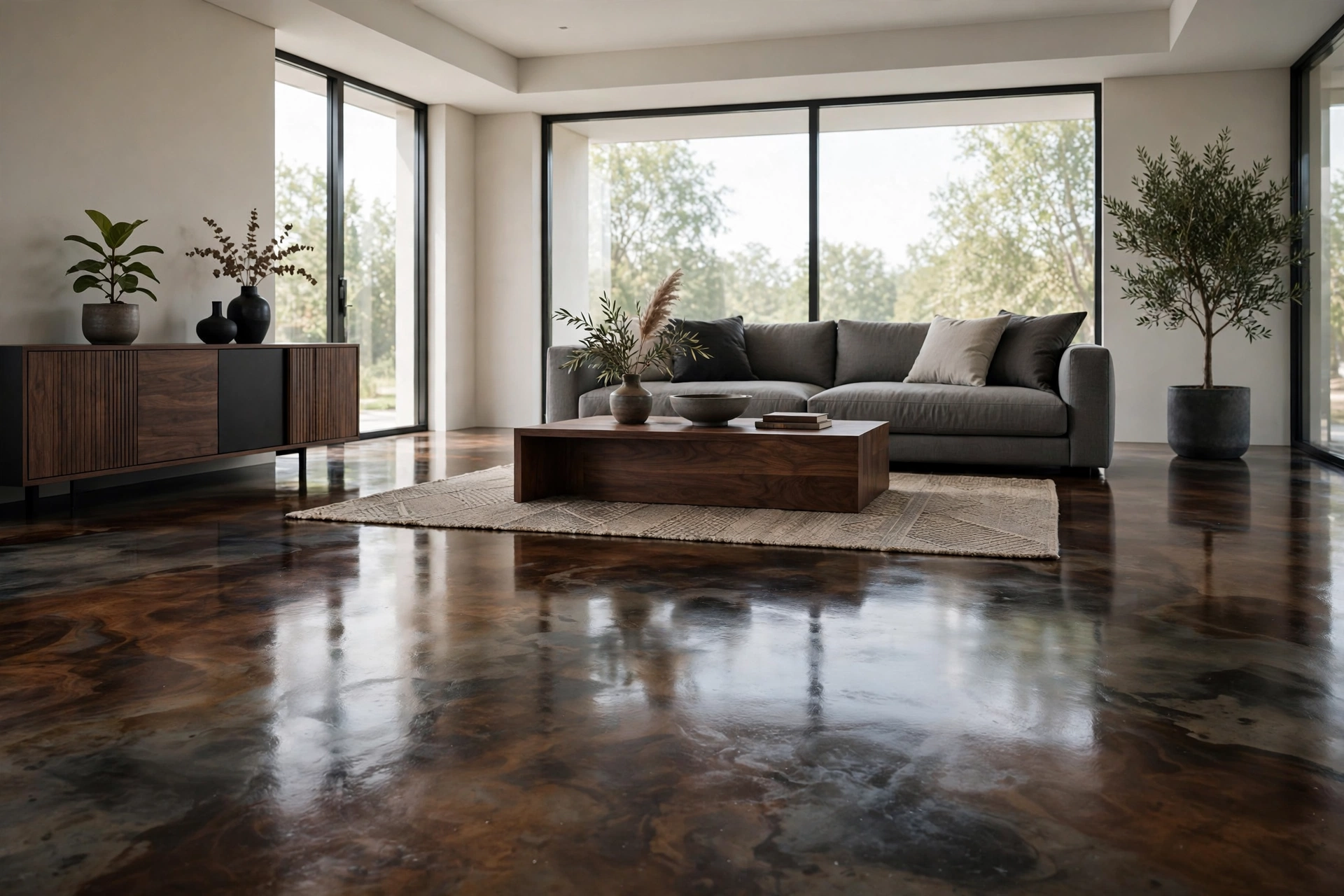
Basements, kitchens, and ground-floor living spaces all take stain well. The slab is already there, so staining turns a structural surface into the finished floor. Water-based products suit indoor work because they are low in odor and VOCs. Indoors, the usual finish is sealer topped with a coat of floor wax. The wax takes the daily wear and can be renewed without touching the color.
One caution belongs to basements. Stain and sealer cannot fix water that pushes up through a slab. Active moisture will cloud finishes and defeat coatings over time. If your basement floor stays damp, solve the drainage first. Our guide to what drain tile is and how it works explains the system that moves that water away. Some homeowners also weigh covering the slab instead of coloring it. Our explainer on what LVP flooring is lays out that option and where it makes more sense.
Patios, Pool Decks, and Walkways
Outdoor slabs are the classic acid stain setting. A broom-finished patio or path takes stain evenly and keeps some grip underfoot. Earth tones sit comfortably next to planting, stone, and timber. Pool decks need one extra decision, though. Any sealed surface gets slicker when it is wet. Manufacturers and contractors both recommend mixing a fine anti-slip additive into the final sealer coat. That small step matters most around pools and on sloped paths.
Garages and Driveways
Garage floors and driveways work harder than any other stained surface. They carry hot tires, oil drips, and constant weather. Penetrating stains hold an advantage here. The color sits inside the slab, so there is no surface film for a hot tire to lift. Some film-forming products warn about exactly that failure on driveways. Whichever product you pick, give the sealer its full curing time before parking on it. Labels commonly ask for several days before tires return.
Concrete Stain vs Paint: Which One Belongs on Your Slab?
Concrete stain vs paint is the comparison most people make first. The two products solve the same problem in opposite ways. Paint forms an opaque film that sits on top of the concrete. Stain moves into the concrete and colors it from within. Nearly every practical difference flows from that single fact.
- Appearance. Paint hides the slab behind one flat, solid color. Stain keeps the texture and natural variation visible.
- Failure mode. Paint chips, flakes, and peels as the film ages and moisture pushes at it. Stain cannot peel, because there is no film to lift.
- Hiding flaws. Paint covers patches, repairs, and old marks. Translucent stain shows them, so repairs stay visible through the color.
- Upkeep. Paint needs full recoating once it starts to fail. Stain needs only its sealer renewed every few years.
- Feel underfoot. A painted film can turn slick and can soften under hot tires. Sealed stain keeps the texture of the slab itself.
Paint still has its place. A badly patched slab, or a floor that needs one exact color, may suit paint better. For a sound slab and a natural finish, stain is the longer-lasting route.
Can All Concrete Be Stained?
Nearly all concrete can be stained, new or old, indoors or out. The surface condition matters far more than the age of the slab. Stain must reach the pores of the concrete to work. Anything that blocks those pores blocks the color.
The common blockers are old sealer, paint, glue, curing membranes, oil, and grease. Sprinkle plain water on the slab to test it. Water that soaks in and darkens the surface means the pores are open. Water that beads and sits on top means a barrier is still present. Barriers come off by stripping, grinding, or sanding, depending on what they are. Very smooth, machine-troweled concrete can also resist stain. Etching or light grinding opens that surface up.
Cracks need attention before any color goes down. Stain settles into a crack and makes it darker and more obvious. Repair the crack first, and let the repair cure fully. Our walkthrough on basement crack repair covers the filling methods that suit floor slabs. Exposed aggregate is the last thing to know. The stones in the surface keep their natural color, because only the cement around them accepts stain.
How Long Does Concrete Take to Cure Before You Can Stain It?
New concrete gains strength slowly as it cures. The standard benchmark for a full cure is about 28 days. Staining has to wait for that cure to finish. Excess water still leaving the slab interferes with both stain types. Most stain and sealer labels tell you to wait at least 28 days after the pour. Some products set the minimum at 30 days.
Weather and the original mix can push the date later. A wet mix, cold temperatures, or heavy rain all slow curing down. In those conditions, experienced installers often wait 30 to 45 days, sometimes longer. Blue-green acid stain colors are the most sensitive of all. They need complete hydration before they develop properly. A useful field sign is color: fresh concrete darkens and lightens in patches as it dries. Once the slab shows one uniform light gray, it is usually ready. Older concrete skips this wait entirely, of course. It only needs the cleaning and testing described above.
How to Stain Concrete: Step by Step
Step 1: Clean the Slab Thoroughly
Sweep and wash the whole surface. Use a concrete cleaner or degreaser matched to the dirt you actually have. Grease needs a degreaser, while plain grime needs only detergent and scrubbing. Work a stiff brush over stubborn patches. Outdoors, algae, mold, and mildew must come off first, since growth under a finish keeps working against it. Our guide to using 30 Seconds Outdoor Cleaner covers that wash in detail. Rinse well and let the slab dry before moving on.
Step 2: Repair, Etch if Needed, and Test
Fill cracks and spalls, and let repairs cure. Etch or grind any slick, sealed-feeling areas so the pores open. Run the water test again on any patch that looked doubtful. Then apply your chosen stain to a small, hidden test area. Seal that test patch too. The sealed patch, not the wet stain, shows the color you are actually buying.
Step 3: Mask, Protect, and Mix
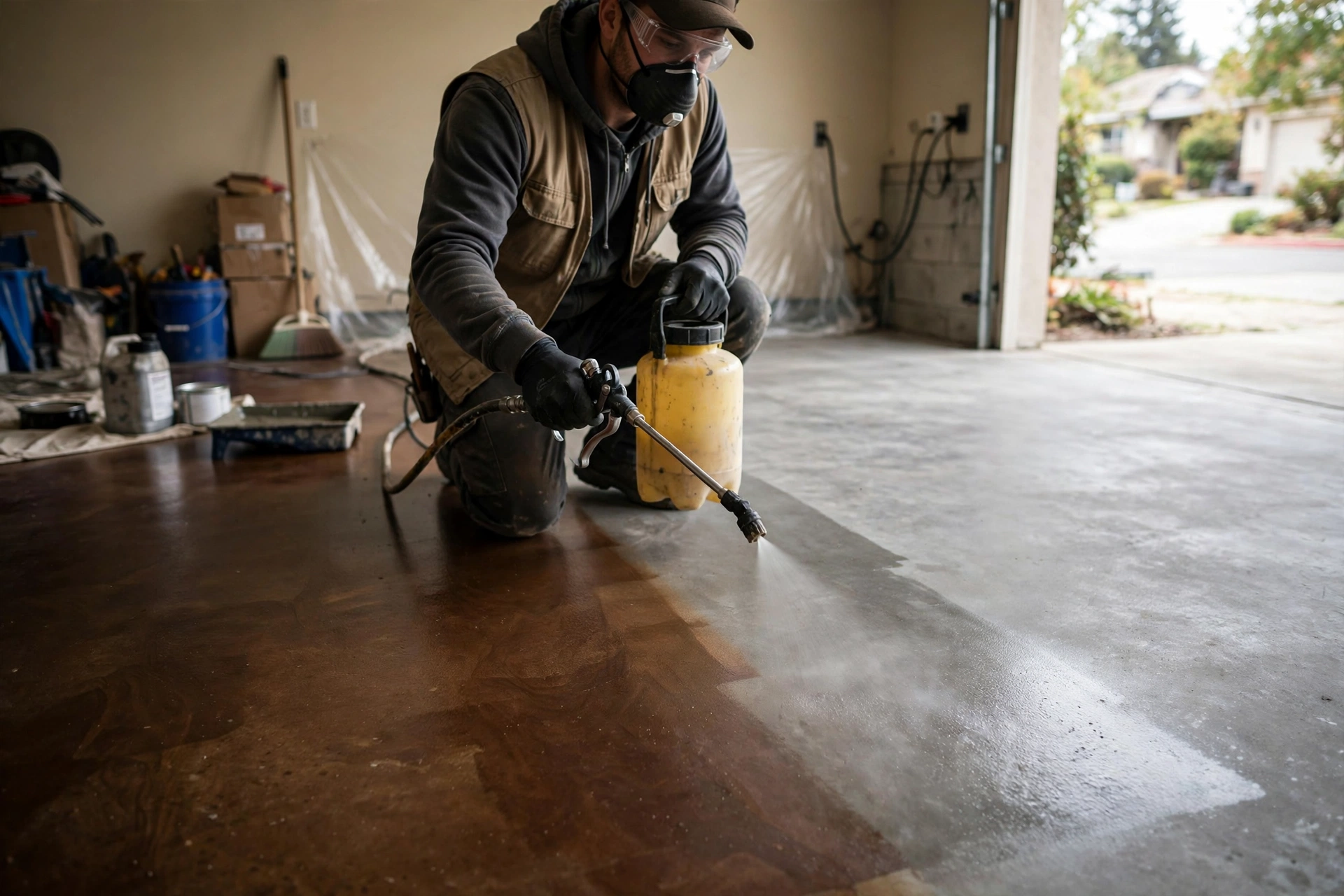
Cover walls, siding, plants, and anything else within splashing range. Plastic sheeting and painter’s tape do the job. Put on chemical-resistant gloves, goggles, and long sleeves for acid stain. Load the stain into a plastic pump sprayer. Never use a metal sprayer with acid stain, because the acid attacks the metal. Some acid stains can be diluted with water, up to one part water to one part stain. Dilution gives lighter shades. Check your product’s label for its own limit.
Step 4: Apply the Stain
Spray in small sections, moving the wand in a loose circular pattern. Keep a wet edge as you go, so no section dries before its neighbour is coated. Dried edges leave visible lap marks. Brush the stain in with a natural-bristle broom for an even finish. Skip the brushing if you want a stronger mottled effect. A light pre-mist of water on part of the slab can deepen the marbling there. Expect coverage of roughly 200 to 400 square feet per gallon for acid stain. Water-based products often cover more, around 400 to 600 square feet per gallon on smooth concrete.
Step 5: Let the Color Develop
Acid stain needs time to react with the slab. Full color development takes about 5 to 24 hours, depending on the brand. Longer contact generally means a deeper final hue. Do not exceed the maximum time on your product’s label. Water-based stains work on a shorter clock. Many are dry to the touch within a couple of hours, with recoats possible the same day. A second coat of either type deepens and evens the color.
Step 6: Neutralise and Rinse (Acid Stain Only)
Once the color has developed, the acid reaction must be stopped. Scrub the surface with an alkaline neutralizing solution. Common choices are trisodium phosphate (TSP) mixed with water, or ammonia or baking soda solutions, per the manufacturer’s directions. Scrub hard with a stiff push broom. Then rinse with clean water, and rinse again. Three or four rinse cycles are normal before the water runs clear. Any residue left behind can leave a white film and block the sealer. Let the slab dry completely afterwards.
Step 7: Seal It — Why Concrete Stain and Sealer Belong Together
Concrete stain and sealer are two halves of one system. The stain supplies color, but it sits in only the top layer of the slab. The sealer supplies the protection against water, oil, and wear. Apply sealer only to a fully dry surface. Two thin coats beat one thick coat. Run the second coat across the direction of the first. Solvent-based sealers darken the color and give a richer, wetter look. Water-based sealers keep pale colors soft and stay closer to the dry tone. Add anti-slip grit to the final coat anywhere the floor gets wet. Indoors, a coat of floor wax over the sealer adds a renewable wear layer. Light foot traffic usually returns within a day. Tires and heavy furniture should wait several days, or as long as the label demands.
How Much Does Concrete Stain Cost?
Professional pricing follows the complexity of the design. A basic job, one color with simple preparation and sealer, runs about $2 to $4 per square foot. Mid-range work with two colors or light patterning lands around $4 to $10 per square foot. Elaborate designs with stencils, saw-cut patterns, and several colors can reach $12 to $25 per square foot. Those ranges come from Concrete Network’s published pricing guidance.
Doing it yourself cuts the labour out of the bill. A gallon of acid stain typically costs around $60. That gallon covers roughly 200 to 400 square feet. Add a gallon of sealer and basic supplies, and a 400-square-foot garage usually stays within a few hundred dollars in materials. The same garage at professional basic rates would cost roughly $800 to $1,600. Your time is the real price of the DIY route. Prep, application, neutralizing, and sealing spread across two days for most projects.
Staining also compares well against replacing the surface. Installing ceramic tile typically runs $11 to $22 per square foot, by Concrete Network’s figures. Staining the slab you already own avoids demolition and new material entirely. That gap is why stained concrete anchors so many budget remodels.
How Long Does Concrete Stain Last? Durability and Maintenance
The color from concrete stain does not carry an expiry date. Acid stain color is a chemical change inside the slab, so it cannot fade out or peel off. Water-based pigment sits in the pores and is similarly durable once sealed. What does wear out is the sealer on top. Foot traffic, tires, sun, and weather all grind that clear layer down slowly. Once the sealer thins, the color below starts to wear with the surface itself.
Maintenance is therefore mostly sealer maintenance. Exterior stained concrete usually needs resealing every two to three years. Interior floors ask for less: a wax coat refreshed as it dulls, and sealer renewed far less often. Daily care is simple. Dust mop or sweep regularly, and wet mop with a neutral-pH cleaner when needed. Concrete Network recommends that neutral cleaner specifically, since harsh chemicals attack the sealer. Steam mops are a poor match for sealed concrete floors. Treat the sealer well, and the color underneath it lasts as long as the slab does.
Mistakes That Ruin a Stained Concrete Finish
- Staining too soon. Color applied to uncured concrete develops weakly and unevenly. The 28-day wait is not a suggestion.
- Skipping the test patch. Acid stain color is permanent and only partly predictable. A sealed test patch is the only honest preview.
- Staining over sealer or paint. Blocked pores mean blocked color. The result is a pale, patchy finish that must be stripped and redone.
- Using a metal sprayer for acid stain. The acid corrodes metal parts and ruins both the tool and the spray pattern. Plastic only.
- Taking a break mid-application. A dried edge between sections prints a permanent lap line. Plan the work so each section flows into the next.
- Skipping the neutralizing wash. Leftover acid residue leaves white film, blotches, and sealer that will not bond.
- Sealing a damp slab. Trapped moisture clouds the sealer and can lift film-forming products. Dry means fully dry.
- Expecting stain to hide damage. Translucent color shows patches, repairs, and old spills. It decorates a sound slab; it does not disguise a broken one.
Frequently Asked Questions
Can I Stain My Concrete Floor Myself?
Yes, and staining suits a careful DIYer well. The process uses basic tools, and water-based products forgive small mistakes more readily. Acid stain is still manageable, but it is permanent and harder to predict. Hire a professional for large areas, multiple colors, or stencilled designs. Pros also earn their fee on old slabs that need grinding and repair first.
Can You Acid Stain Old Concrete?
Yes, old concrete stains well, and most residential jobs are on older slabs. The difference is preparation. Old surfaces usually carry sealer, paint splashes, oil, or ground-in dirt. Each of those has to come off before the stain can reach the pores. Expect the prep to take longer than the staining itself.
Can You Acid Stain Colored Concrete?
Yes, integrally colored concrete can be stained. The existing color acts as a base coat, though. It shifts whatever stain color goes over it. A brown stain over reddish concrete lands warmer than the same stain over plain gray. This is another case where the test patch earns its keep.
What Happens If You Don’t Neutralise an Acid Stain?
The chemical reaction keeps working past the color you wanted. Leftover residue also interferes with the finish. Contractors link skipped neutralizing to splotchy color and sealer that bonds poorly. The wash takes effort, but it is the step that locks the result in place.
Is Stained Concrete Slippery When Wet?
It can be, especially under a gloss sealer. The stain itself adds no slipperiness; the smooth sealed surface does. A matte sealer keeps more of the slab’s natural texture. For pool decks, paths, and bathroom floors, mix an anti-slip additive into the final sealer coat. Manufacturers sell these additives for exactly this purpose.
Does Concrete Stain Peel Like Paint?
No, correctly applied stain has nothing to peel. The color sits inside the concrete rather than in a film on top. A peeling finish usually means a film-forming product went over a sealed or damp slab. It can also mean excess stain residue was sealed in instead of rinsed away. Both are preparation failures, not stain failures.
Does Stained Concrete Increase Home Value?
It is generally viewed as an upgrade, though no honest source can promise a figure. Decorative concrete turns a plain slab into a finished surface at modest cost. Real estate writers commonly list stained floors and patios among curb-appeal improvements. Peeling painted concrete, by contrast, tends to read as deferred maintenance. Treat value gain as a likely bonus, not the reason for the project.

1 Comment
Pingback: Home Loan Calculator: Estimate a Monthly Mortgage Payment