


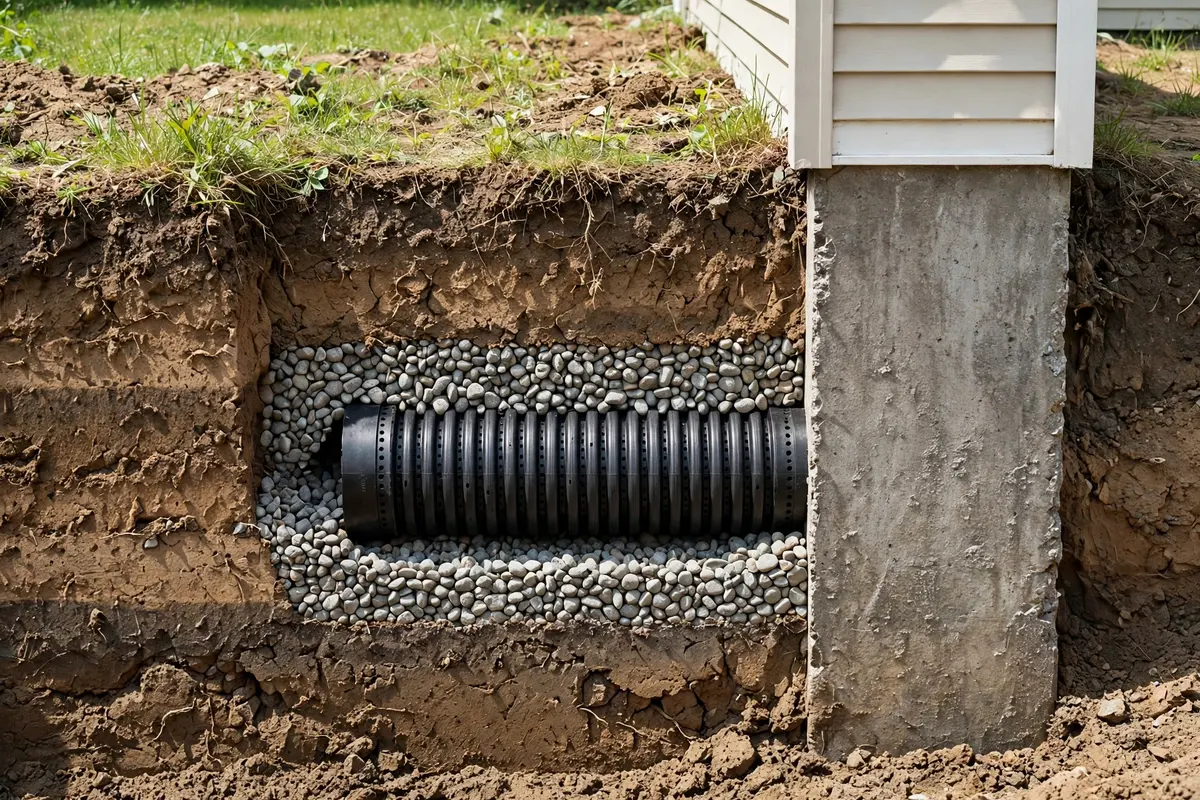
Drain tile is a network of perforated pipe buried alongside your home’s foundation footing that collects groundwater and carries it away before that water can enter your basement. Despite the name, modern drain tile is not tile at all. It is usually 4-inch perforated PVC or flexible corrugated plastic pipe, set in washed gravel at footing level. Water in the surrounding soil seeps through the gravel, enters the holes in the pipe, and flows to a sump pit, where a sump pump discharges it away from the house, or to a daylight outlet where the lot allows it. A drain tile system works by giving groundwater an easier path than your basement floor and walls.
That idea explains a lot of wet-basement problems. Rain and snowmelt saturate soil around a foundation, and as the water table rises, pressure builds under the floor and against the walls. Water pushes through the cove joint where wall meets floor, through small slab cracks, and through the pores in concrete itself. Drain tile relieves that pressure at the footing, the lowest and widest part of the foundation.
How Does a Drain Tile System Work?
A drain tile system works in four steps.
First, groundwater moves through soil toward the foundation. The trench around the footing is filled with washed gravel, which has large open spaces between the stones. Water moves through gravel far faster than through packed soil, so the gravel bed becomes the easiest route around your home.
Second, water reaches the perforated pipe, which sits in the gravel with its holes facing down or angled down. Water rises into the pipe through those openings. Gravel large enough not to enter the holes also acts as a first filter.
Third, filter fabric, or a fabric sock over the pipe, keeps fine silt from migrating into the gravel and pipe. This matters more in silty or clay-heavy soil, where fine particles cause slow clogging.
Fourth, collected water travels to its discharge point. In most interior systems and many exterior ones, that point is a sump pit inside the basement, where a pump sends water outside. Where a lot slopes away, an exterior system may instead drain to daylight, an open outlet downslope. Many lots lack enough slope for that, which is why the sump pump pairing is so common.
For how this fits into other projects, see our complete home improvement guide.
Why Is It Called Tile If There Is No Tile?
The name is a leftover. Early footing drains were built from short clay pipe sections laid end to end in a trench. Those sections looked like roofing tiles, so builders called them tiles, and the gaps between sections let water in. Soil movement and tree roots could separate or crack the clay. Modern plastic pipe comes in long lengths and has factory-made perforations instead. You may also hear this system called a footing drain, perimeter drain, or weeping tile.
Interior vs. Exterior Drain Tile
Drain tile can sit on either side of the foundation wall. Both versions sit at or near footing level. The location changes cost, disruption, and access.
Exterior drain tile
An exterior drain tile system runs along the outside of the footing. Builders usually install it during new construction, when the trench is still open. Pipe goes in beside the footing, gets covered with gravel and fabric, and the trench is backfilled. This catches groundwater before it reaches the wall.
Retrofitting one is a much bigger job. A crew must excavate the full perimeter to the footing, often 8 to 10 feet deep, which can mean removing decks, porches, shrubs, and walkways, then restoring them. Exterior retrofits are usually considered only when other work already requires digging, or the wall itself needs repair.
Interior drain tile
An interior drain tile system runs along the inside perimeter of the basement, under the concrete floor and next to the footing. A crew cuts a narrow trench in the slab, digs down beside the footing, lays perforated pipe in gravel, connects it to a sump pit, and pours new concrete over the trench.
Interior systems manage water that has already passed under or through the foundation, and relieve pressure directly under the floor. That suits water coming up through the cove joint or slab. They are also easier to reach later, since a contractor can inspect the system from inside instead of digging up the yard.
The trade-off is disruption inside. Stored items and flooring near the walls have to move, and concrete work creates dust and noise for a day or two. Once the floor is patched, the basement can be finished again. Homeowners planning that step often think about flooring here, and understanding what LVP flooring is can help, since luxury vinyl plank handles basement conditions better than many other coverings.
French Drain vs. Drain Tile: What Is the Difference?
Homeowners often compare French drain vs. drain tile as if they were competing products. They are close relatives, and the terms get used interchangeably, which causes confusion. Both use perforated pipe in gravel. The practical difference is depth and purpose.
| Feature | French drain | Drain tile |
|---|---|---|
| Typical depth | Shallow, often 8 to 24 inches below the surface | At footing level, often 8 to 10 feet below the surface |
| Main job | Move surface water and shallow runoff | Collect groundwater at the foundation |
| Common location | Yard, along a slope, behind a retaining wall | Along the foundation footing, inside or outside |
| Water problem it solves | Pooling water, soggy lawn, runoff heading toward the house | Wet basement, seepage at the floor joint, pressure under the slab |
| Discharge | Usually gravity to a lower outlet | Usually a sump pit and pump, sometimes gravity to daylight |
A shallow yard drain cannot relieve pressure at a footing several feet below it. If water stands in the lawn after rain, a French drain may be the right tool. If a basement seeps at the base of the wall or through the floor, that is a footing-level problem, and drain tile addresses it directly. The two can also work together, with the yard drain reducing the load on the footing drain.
For a very different kind of home protection, our Tech guide to using a password manager explains how Google Password Manager keeps your logins safe.
Signs Your Drain Tile Is Missing, Failing, or Overwhelmed
Foundation drainage rarely fails in a single day. It weakens slowly, and the basement shows warning signs first.
- Water appears at the cove joint or rises through floor cracks during heavy rain or snowmelt.
- Damp patches at the base of the wall never fully dry out.
- A musty smell returns even after cleaning and running a dehumidifier.
- White, chalky residue called efflorescence shows on concrete, a sign water has moved through it.
- The sump pump runs constantly during wet weather, or the pit stays unusually full.
- Puddles return in the same spot hours after you mop them up.
One sign alone may have a simpler cause. A downspout dumping water next to the wall, or soil graded toward the house, can mimic a drainage failure. Check gutters, downspout extensions, and grading first, because those fixes are cheap. If several signs appear together, the perimeter drain itself becomes the likely suspect.
Older homes deserve extra attention. Clay tile can crack or separate, corrugated pipe can get crushed by poorly compacted backfill, and systems built without filter fabric can fill with silt over decades. In some regions, iron bacteria form a reddish, jelly-like buildup called iron ochre that coats pipe openings and slows flow.
How Drain Tile Is Installed
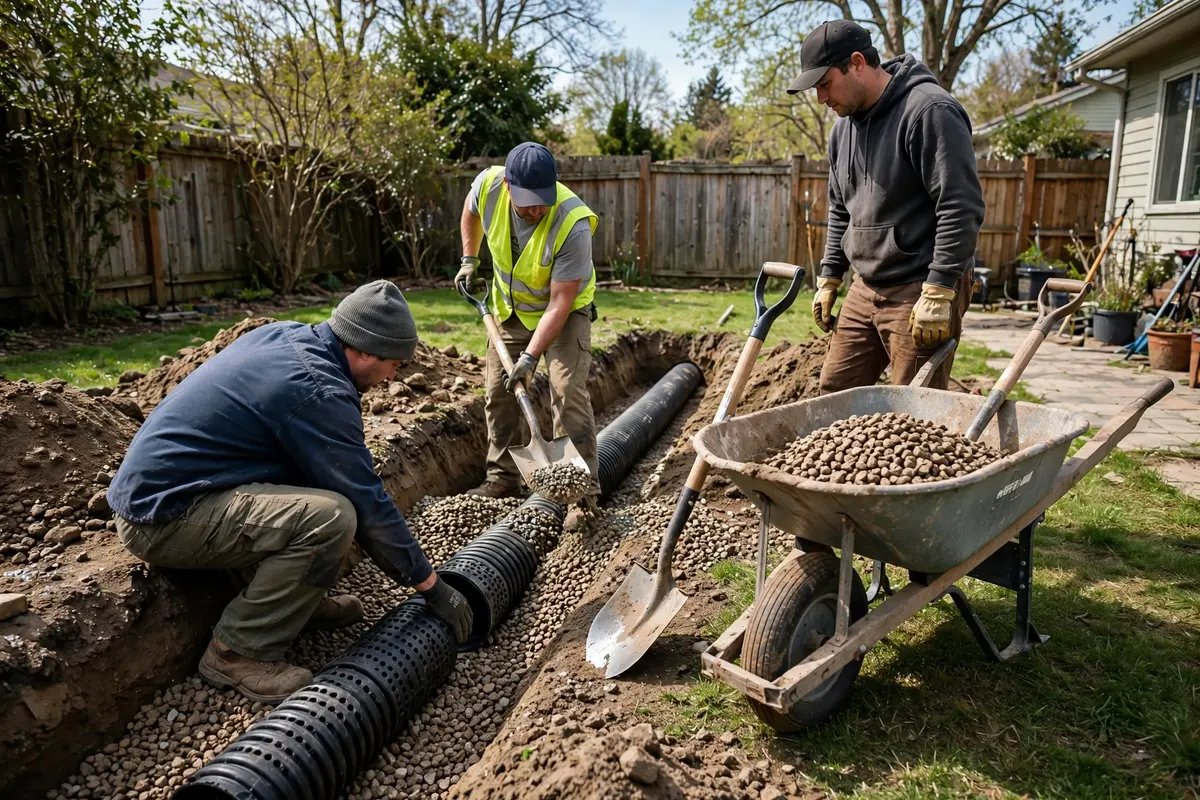
The sequence is similar inside and outside.
- The crew exposes the footing, by excavating outside or cutting the slab inside.
- A bed of washed gravel goes down beside the footing.
- Perforated pipe is laid in the gravel at footing level, top of pipe no higher than top of footing. Perimeter runs are often laid close to level, since the pipe is perforated and surrounded by gravel. The solid pipe carrying water to daylight is the part that needs a clear slope.
- More gravel covers the pipe, with filter fabric over it where the design calls for it.
- The pipe connects to a sump pit or discharge line. Inside, the crew restores the floor. Outside, the crew backfills.
Two details separate a lasting job from a short-lived one. Gravel must be clean and coarse, since gravel mixed with sand slows water and feeds clogging. And downspouts should not connect directly into the footing drain, which overloads it during storms and can push roof debris into a pipe built for groundwater.
Does a Drain Tile System Need Maintenance?
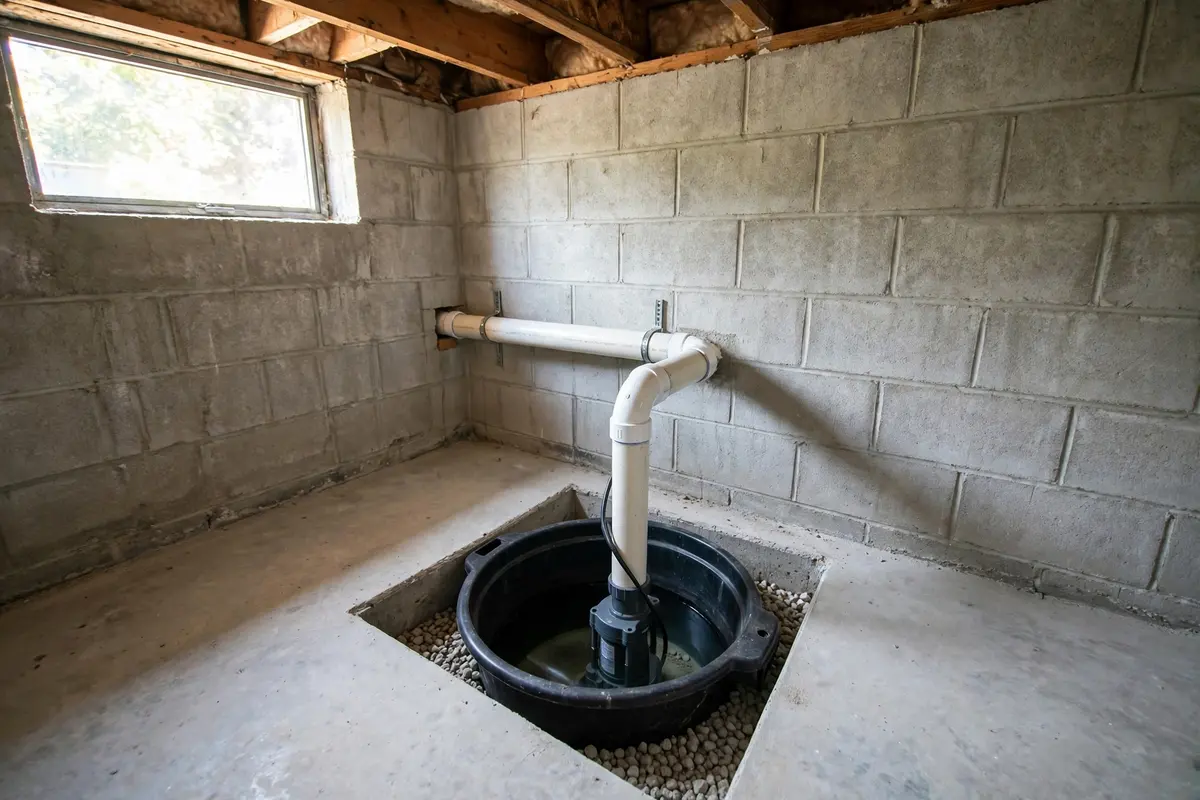
A well-built interior system needs little attention to the pipe itself. It sits under concrete, protected from soil movement, and gravel and fabric do the filtering. Contractors disagree on whether periodic clean-outs add value, and there is no single standard. What nearly every source agrees on is the sump pump.
The pump is the moving part, so it can fail. Pour a bucket of water into the pit now and then to confirm the pump starts, clears the pit, and shuts off. Check that the outside discharge line is open. If your area loses power during storms, a battery backup pump is worth considering, because the heaviest load often arrives with the weather that knocks out electricity. Exterior systems are harder to service, since reaching the pipe means excavation — one reason many retrofits choose the interior route.
What Does Drain Tile Cost?
Prices published by contractors and cost guides vary widely, and they conflict enough that a single reliable figure does not exist. Cost depends on interior vs. exterior placement, perimeter length, excavation depth, soil, local labor rates, permits, and how much finished surface must be removed and restored. Exterior retrofits cost far more than interior work in most published comparisons, mainly because of digging and restoration.
Treat any per-foot figure online as a rough local estimate, not a quote. Get written estimates from more than one contractor, and ask what each includes: sump pump, backup pump, concrete or landscaping restoration, and disposal. Those inclusions explain much of the gap between bids.
Frequently Asked Questions
Is drain tile the same as a French drain?
No, not exactly. Both use perforated pipe in gravel, but a French drain is usually shallow and handles surface water in a yard, while drain tile sits at footing level and handles groundwater at the foundation. Ask a contractor exactly where the pipe will sit.
Does every house have drain tile?
No. Many newer homes have a footing drain because building codes in many areas require foundation drainage, but older homes may have clay tile, a partial system, or none at all. A contractor can often check through the sump pit or with a camera where access exists.
Can drain tile clog?
Yes, although a properly built system resists clogging for a long time. Silt entering through missing or damaged filter fabric, crushed pipe, separated clay sections, tree roots in old joints, and iron ochre buildup can all reduce flow.
Do I need a sump pump with drain tile?
In most interior systems, yes. The pipe delivers water to a sump pit, and the pump removes it from the house. An exterior system on a sloped lot may drain to daylight by gravity instead, but many lots are too flat for that.
How long does a drain tile system last?
There is no fixed lifespan for every home. Modern plastic systems are often expected to work for decades when bedded in clean gravel and protected by fabric, while older clay systems may be near the end of their service life. Soil type, groundwater chemistry, and installation quality matter more than pipe material alone.
