


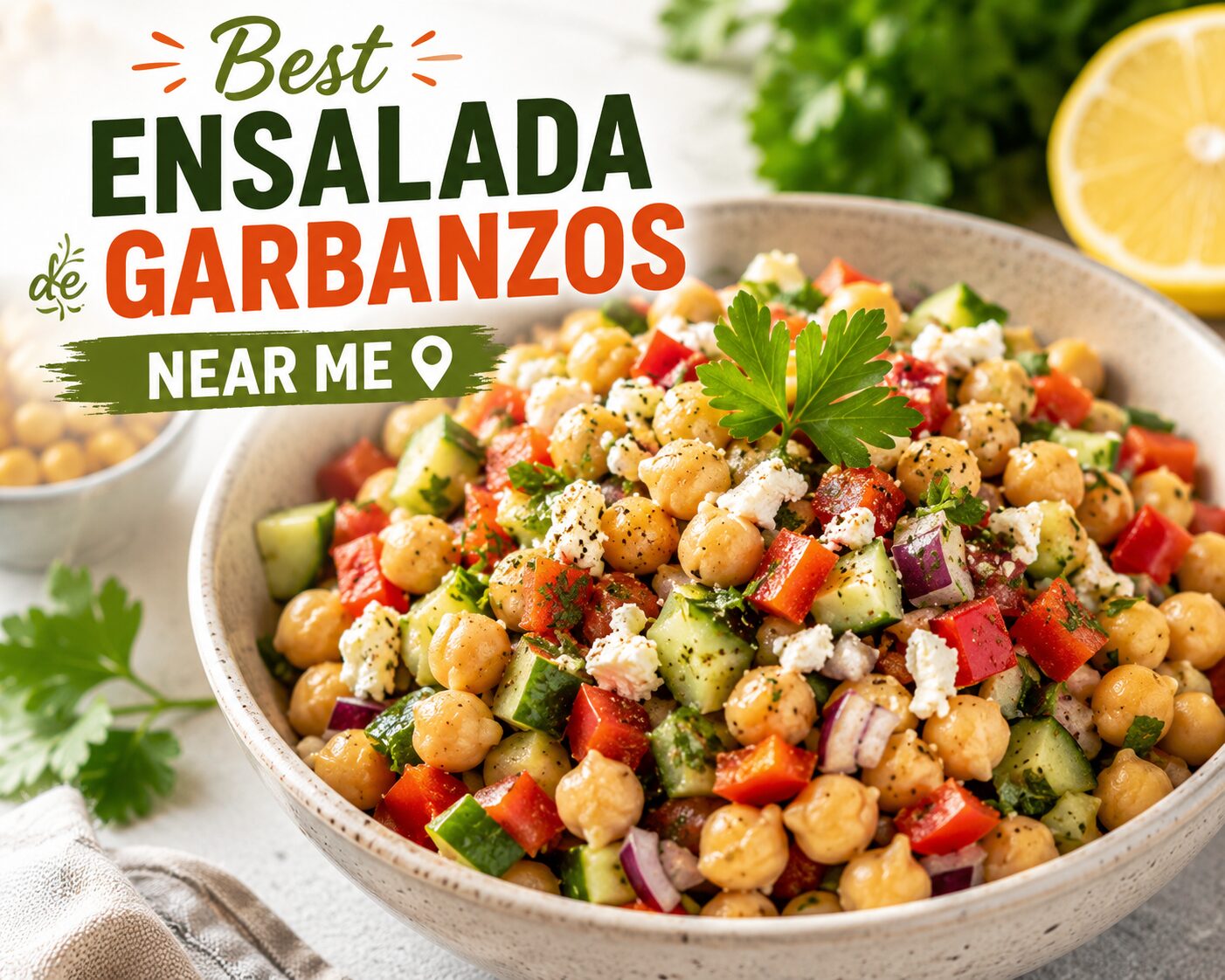
If you’re searching for the best ensalada de garbanzos near me, here’s the direct answer: you want a Spanish tapas restaurant or a Spanish deli counter, not just any “Mediterranean restaurant,” since the Spanish version of this dish, built with tuna or salt cod, hard boiled egg, piquillo peppers, and a sherry vinegar dressing, is genuinely different from the generic chickpea salad served at most Middle Eastern or Mediterranean spots.
Ensalada de garbanzos is a Spanish chickpea salad traditionally made with chickpeas, bell peppers, onion, capers or olives, and either canned tuna or flaked salt cod, dressed simply in extra virgin olive oil and sherry vinegar. It’s most closely associated with Castilla-La Mancha, though you’ll find versions of it across Spain as both a tapa and a light main course.
The Confusion Most Guides Never Clear Up
Here’s something worth clearing up before anything else. When most articles talk about finding the best ensalada de garbanzos near me, they point you toward “Mediterranean restaurants” broadly, as if any chickpea salad counts. It doesn’t, and that distinction actually matters for what you’ll get served.
A Middle Eastern chickpea salad often leans on cumin, sumac, and a lemon-tahini style dressing, which is a completely different flavor profile from the Spanish version. If you walk into a generic Mediterranean spot expecting the sherry vinegar and tuna combination, you might be disappointed, not because the kitchen did anything wrong, but because you ordered a different dish that happens to share one main ingredient.
What’s Actually In an Authentic Version
I noticed this difference firsthand the first time I ordered chickpea salad at a Lebanese restaurant expecting something closer to what I’d had at a Spanish tapas bar. The Lebanese version was excellent in its own right, bright with lemon and parsley, but it had nothing resembling the tuna, egg, and piquillo pepper combination I was picturing.
A properly made Spanish ensalada de garbanzos includes tender, whole chickpeas, diced red and green bell peppers, finely chopped onion, and usually either oil packed tuna (often labeled ventresca) or desalted, flaked salt cod. Hard boiled eggs and a few capers or olives typically round it out, and the whole thing gets dressed simply in good olive oil and sherry vinegar rather than anything creamy.
What Separates a Good One From a Bland One
The clearest sign of quality is the chickpea itself. It should hold its shape and have a slight bite, not be mushy or falling apart, and the skins shouldn’t look blown out or split from overcooking. A kitchen that rushes the chickpea cooking step usually ends up with a salad that turns to mush by the time it’s dressed.
The dressing matters just as much. Sherry vinegar has a distinct sharpness that plain white vinegar or lemon juice doesn’t replicate, so if the best ensalada de garbanzos near me you’re served tastes flat or one dimensional, there’s a decent chance the kitchen substituted a generic vinegar instead of the real thing.
Regional and Kitchen Variations Worth Knowing
Not every kitchen builds this dish the same way, and that’s genuinely fine. Some versions use canned tuna packed in olive oil rather than the pricier ventresca cut, while others skip fish entirely in favor of just egg and vegetables for a lighter, more affordable version. A few restaurants add roasted piquillo peppers for sweetness instead of raw bell pepper.
It depends heavily on the specific kitchen and what they’re going for. If you order the best ensalada de garbanzos near me at two different Spanish restaurants and get noticeably different results, that’s a legitimate stylistic choice rather than one restaurant getting the recipe wrong.
Dietary and Allergy Considerations
This is a detail almost none of the other coverage on this keyword actually addresses. Traditional versions contain fish, either tuna or salt cod, along with egg from the hard boiled eggs, so this dish isn’t automatically vegan or vegetarian the way a plain chickpea salad might be assumed to be.
That said, a fully plant based version does exist and is common enough to request. If you’re ordering the best ensalada de garbanzos near me for someone who’s vegan or has a fish allergy, ask specifically whether the tuna or salt cod can be left out, since the base salad of chickpeas, peppers, onion, and olive oil dressing works perfectly well without it.
Reasonable Price Expectations
At a casual Spanish tapas restaurant, a tapa sized portion typically runs somewhere in the 6 to 10 dollar range, while a full sized entree portion can run 12 to 18 dollars depending on whether it includes the tuna or salt cod. Prepared versions from a Spanish deli counter tend to run cheaper by the pound, often in the 8 to 12 dollar per pound range.
I paid around 8 dollars for a tapa portion at a small family run Spanish restaurant, and the chickpeas were noticeably firmer and better seasoned than a similarly priced version I tried later at a larger chain restaurant that clearly used canned chickpeas straight from the tin without any additional seasoning.
How to Judge Quality Before You Order
A few quick questions can help you avoid a disappointing plate. Ask whether the salad uses ventresca tuna, standard canned tuna, or salt cod, since that answer alone tells you a lot about how seriously the kitchen treats the dish. A vague or uncertain answer often means it’s a prepackaged version rather than something made in house.
It also helps to ask whether the dressing uses sherry vinegar specifically. Kitchens that take the trouble to stock sherry vinegar for this one dish tend to be the same kitchens paying attention to the rest of the details, like properly cooked chickpeas and fresh vegetables rather than pre-cut, days old produce.
Bringing It All Together
If your search for the best ensalada de garbanzos near me keeps landing you at generic Mediterranean spots serving a completely different chickpea salad, start searching specifically for Spanish tapas restaurants or Spanish delis instead, since that distinction is the single most useful filter for finding the actual dish you’re picturing.
One thing worth trying if you enjoyed sorting out this confusion: the same kind of mix-up happens with other Spanish dishes that get lumped into broad category searches, like tracking down the best pollo al chilindrón near me, which gets similarly buried under generic “Spanish food near me” results instead of being searched for by its actual name.
Frequently Asked Questions
What is ensalada de garbanzos exactly?
Ensalada de garbanzos is a traditional Spanish chickpea salad made with chickpeas, bell peppers, onion, and either tuna or salt cod, along with hard boiled egg, capers or olives, dressed in olive oil and sherry vinegar rather than any creamy dressing.
Is ensalada de garbanzos the same as Middle Eastern chickpea salad?
No. The Spanish version relies on sherry vinegar, olive oil, tuna or salt cod, and egg, while Middle Eastern chickpea salads typically use cumin, sumac, lemon juice, and sometimes a tahini based dressing, giving them a distinctly different flavor.
Is ensalada de garbanzos vegan?
Not in its traditional form, since it usually contains fish and hard boiled egg. A plant based version without the tuna, salt cod, and egg is common and can typically be requested at restaurants that serve the dish.
Does ensalada de garbanzos contain gluten?
The traditional recipe is naturally gluten free, since it relies on chickpeas, vegetables, fish, egg, and an oil and vinegar dressing with no flour or bread involved, though it’s worth confirming with the specific restaurant.
Where can I find an authentic version near me?
Spanish tapas restaurants and Spanish delis are the most reliable source, since generic Mediterranean or Middle Eastern restaurants typically serve a different style of chickpea salad that doesn’t include the tuna, egg, and sherry vinegar combination.
How can I tell if a restaurant’s version is authentic?
Ask specifically whether they use sherry vinegar and whether the protein is tuna, ventresca tuna, or salt cod. A specific, confident answer to either question is a strong sign the kitchen makes the traditional version rather than a generic substitute.
