


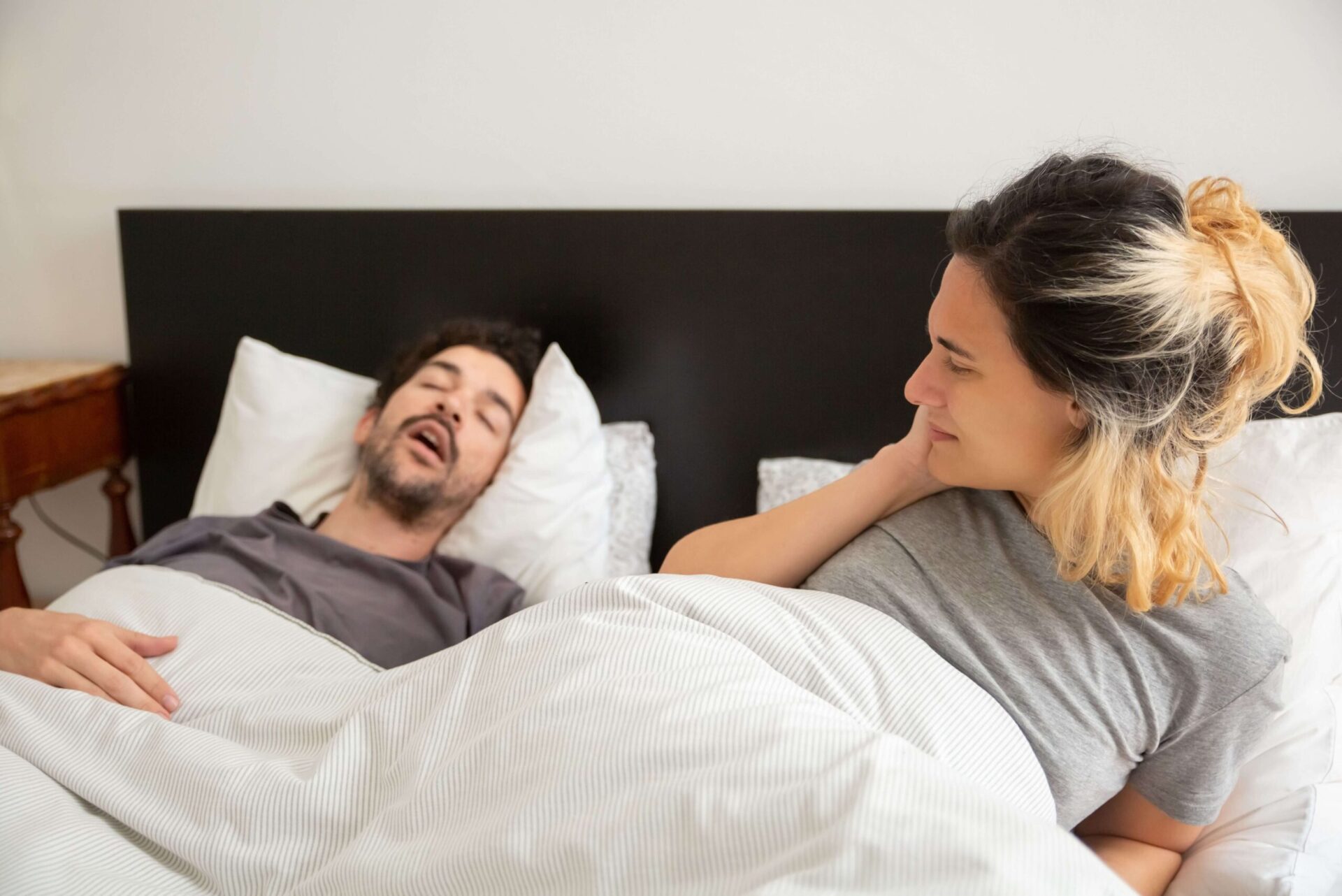
If you’re trying to figure out how to stop snoring, the honest answer is that there’s no single fix, because snoring isn’t one problem. What quiets it for one night, propping yourself up, skipping a drink, isn’t the same thing that fixes it for good. The two get mixed together in most advice, which is why people try one tip, it half-works, and they give up on the rest.
It helps to split this into three separate questions: what can you do right now, what should you test this week to find your actual cause, and what’s worth committing to long-term.
Tonight: What Can Actually Quiet It
Elevating your head and upper back, not just your head on a taller pillow, but your torso at an angle, reduces the amount of soft tissue sagging into your airway. A wedge pillow does this more reliably than stacking regular pillows, which tend to just bend your neck instead of changing your torso angle.
If congestion is part of the picture, a saline nasal rinse right before bed clears mucus in a way that decongestant sprays can’t match without rebound effects the next night. This won’t touch snoring that isn’t nasal in origin, but if you’ve got a stuffy nose on top of snoring, it’s worth ruling out first since it’s the fastest thing to fix.
Side-sleeping helps the same night it’s tried, for people whose snoring is position-dependent. The catch is that most people roll onto their back within an hour of falling asleep without realizing it, so the tennis-ball-in-a-shirt trick exists specifically to make that position uncomfortable enough to interrupt.
None of these fix an underlying cause. They reduce a symptom for one night, which is useful when you need sleep now, but it’s not the same as solving why the snoring is happening.
This Week: Figuring Out What’s Actually Causing It
The mistake most people make is changing three things at once, a new pillow, cutting alcohol, and a nasal strip, then having no idea which one helped when the snoring improves. Test one variable per week if you can stand it, or at minimum, track which nights you drank, which position you woke up in, and whether congestion was a factor, so you’re working from a pattern instead of a guess.
Alcohol and sedatives relax the muscles holding your airway open, not just the ones controlling movement. That’s a specific, testable mechanism: if snoring is dramatically worse on nights you’ve had a couple of drinks and close to silent on nights you haven’t, the cause is largely muscular relaxation, and the fix is behavioral, not a device.
If snoring happens regardless of position, alcohol, or nasal clarity, the cause is more likely structural, tongue size relative to your mouth, jaw position, or tonsil size, and no amount of pillow adjustment will change that. This is the group that benefits most from a mandibular advancement device, which repositions the lower jaw slightly forward to open the airway mechanically rather than trying to reduce tissue relaxation.
Long-Term Fixes That Actually Stick
For people carrying extra weight specifically around the neck, that tissue narrows the airway directly, and losing even a modest amount, often less than what feels like a meaningful amount on a scale, can noticeably reduce snoring. This doesn’t apply to people who snore and are already lean; their cause is almost always anatomical rather than weight-related, and treating it as a weight problem wastes months.
A custom-fitted mandibular advancement device from a dentist who works in sleep medicine tends to outperform the over-the-counter boil-and-bite versions, mainly because a poor fit either doesn’t move the jaw enough to help or moves it too far and causes jaw soreness that makes people stop using it within weeks. If an OTC version helped somewhat but wasn’t comfortable enough to keep wearing, that’s usually a fit problem, not a sign the approach doesn’t work for you.
Treating chronic nasal obstruction, whether that’s allergies that never really clear or a structural issue like a deviated septum, addresses snoring at the source instead of managing around it nightly. This is the slower fix on this list, but it’s the one that removes the need for nightly workarounds entirely.
The One Trend Worth Being Careful With
Mouth taping, sealing your lips shut at night to force nasal breathing, has gotten popular fast, and the evidence hasn’t caught up to the hype. A 2025 systematic review of the available research found the data too thin to recommend it broadly, and flagged a real safety issue: if you have any nasal obstruction or undiagnosed sleep apnea, taping your mouth removes your backup airway. For someone whose airway is already narrowing or closing at night, that’s not a minor downside.
If you breathe easily through your nose during the day and have no signs of sleep apnea, the risk for most people is genuinely low. It’s just not the safe-by-default fix it’s marketed as, and it does nothing to address whatever tissue is causing the vibration in the first place.
When It Stops Being Just Snoring
| Signal | What It Usually Means |
|---|---|
| Snoring only on your back, quiet on your side | Positional, likely tongue falling backward |
| Snoring worse after drinking, minimal otherwise | Muscle relaxation from alcohol |
| Snoring with gasping, choking, or witnessed breathing pauses | Possible obstructive sleep apnea — needs a sleep study |
| Loud snoring plus morning headaches or daytime exhaustion | Possible sleep apnea, even without noticed pauses |
| Snoring unaffected by position, alcohol, or nasal clarity | Likely structural (tongue, jaw, tonsils) |
The middle two rows in that table are the ones people talk themselves out of taking seriously. Snoring by itself is usually just annoying. Snoring with gasping, choking sounds, or breathing pauses your partner has noticed is a different category entirely, and it’s worth a sleep study rather than another product. Obstructive sleep apnea carries real cardiovascular risk over time, and none of the fixes above, pillows, sprays, devices, treat it.
Frequently Asked Questions
What stops snoring immediately, tonight? Elevating your torso and sleeping on your side are the two changes that can work the same night, though only for snoring that’s position-related to begin with. Neither addresses an underlying structural cause.
How long should I try something before deciding it doesn’t work? About two weeks for anything behavioral, position changes, avoiding alcohol, nasal treatments, since a few good nights early on can be coincidence. Devices like mandibular advancement guards often need an adjustment period too, so give a new one at least a week before judging fit and comfort.
Can snoring be cured completely, or just managed? It depends on the cause. Alcohol-driven and positional snoring can effectively resolve once the trigger is removed. Structural causes, jaw position, tonsil size, are usually managed rather than cured, unless the underlying structure is surgically addressed, which is a separate conversation with an ENT.
Is it normal for snoring to get worse with age? Yes, and it’s mechanical rather than mysterious. Muscle tone in the throat decreases with age the same way it does elsewhere in the body, so the same airway that stayed open at 30 may not at 50 without extra help.
My partner says I stop breathing sometimes. Should I be worried? Yes, enough to bring it up with a doctor rather than trying another pillow first. Witnessed breathing pauses are one of the clearest signs of obstructive sleep apnea, and it’s diagnosed with a sleep study, not guessed at from symptoms alone.
